Pocket Park or Small Square: What Each Space Is For
Pocket park or small square: learn what each space invites people to do, and how planting, paving, edges and everyday use shape a neighbourhood pause.
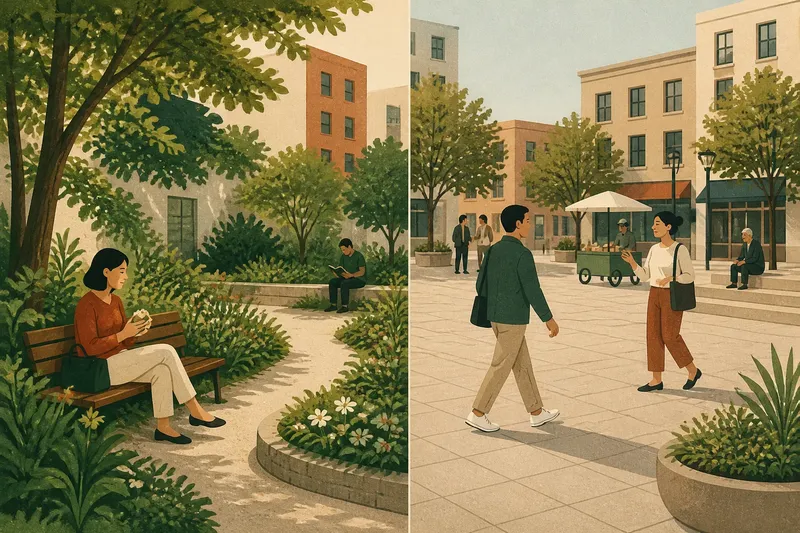
At lunchtime, one neighbour slips beneath a tree with a sandwich while another crosses an open paved patch to meet a friend. A pocket park or small square can occupy a similarly modest gap in the street, yet invite very different behaviour. One offers a little shelter among plants; the other gives people room to meet, pass through or make their own temporary use of the ground.
That distinction matters when you are reading a neighbourhood, choosing a place to stop or considering what a neglected space might need. Rather than judging by size or by the presence of a bench, look at what the space makes comfortable: lingering quietly, gathering visibly, or moving across it without ceremony.
The planted pause
A pocket park is usually a small public green tucked into the street pattern. It may sit on a former building plot, beside a road or between blocks. Its planted character does more than add colour. Trees, shrubs, grass and garden beds form a softer setting, with edges that can make a brief pause feel separate from traffic and shopfront activity.
Planting also shapes where people settle. A bench beneath a tree suggests a shaded stop; a low wall beside a garden bed offers somewhere to sit without formally announcing itself as a seat. A path through the greenery can make a short cut feel pleasant, while a tucked-away corner may suit someone reading alone. The best fit depends on the layout, not on a universal recipe.
Small parks are not automatically quiet or secluded. A playground, a busy path or a street-facing bench can make one lively. But plants tend to divide space into smaller pockets of use. People can be close together without having to face one another or occupy the same open centre. That is useful for a short rest, a conversation at low volume or a pause with a child.
The open meeting ground
A small square is generally more open and harder underfoot. Paving creates a continuous surface where people can cross, gather or arrange themselves without threading between beds and trunks. Its edges might be formed by buildings, steps, shopfronts, a bus stop or a row of seats. The square’s character comes from how these edges meet the open middle.
That clear ground can accommodate varied activity. Someone may wait for a companion, a group may gather before walking on, or a stall may occupy part of the space if local arrangements allow it. The square does not need to be empty to feel flexible; a few seats, trees or planters can give it structure while leaving a useful route through.
Openness has a trade-off. A broad paved centre can feel exposed in strong sun or wind, and a space with no comfortable edges may invite crossing more readily than staying. Look for shade, places to sit and signs that people can pause without blocking a route. A square that works as a shortcut can still be a meeting place, but the two uses need to coexist without crowding one another.
Read the invitation
To decide what a particular space is for, observe it at ordinary times rather than relying on its name or a map symbol. Visit on a weekday and again when nearby shops, schools or community venues are active. Notice where people slow down, where they sit, whether they look towards one another, and which paths remain clear.
Then read the physical clues. A useful set of questions is:
- Where is the shade? Note whether trees or canopies cover a seat or only the edge. If shade is scarce, a midday stop may be uncomfortable.
- Are there several kinds of seat? A bench, a broad step and a low wall support different group sizes and ways of resting. If every seat faces one direction, the space may feel less suited to informal conversation.
- How does planting shape movement? Beds can create a sheltered nook or narrow a route. If people keep stepping around an obstacle, the route may need a clearer opening.
- Can you cross without weaving? Look for a direct path between entrances and the surrounding street. If people cut across a planted area, the formal path may not match the route they need.
- What faces the space? Doors, windows and active uses can make an edge feel watched and lively; blank walls may leave the centre without much connection to its surroundings.
- Is there room to stop without stopping others? A square needs clear movement lines as much as a park does. If waiting people cluster at a narrow entrance, a seating spot set slightly aside may help.
What should you look for?
Can a pocket park work without much grass?
Yes. Trees, planted beds and a sheltered seat can give a small space a park-like quality even where most of the ground is paved. The question is whether the planting creates a comfortable place to pause, rather than serving only as decoration.
Does a square need a completely open centre?
No. A few trees, movable chairs or planters can make an open space easier to use, provided they do not obstruct the main paths. The centre should remain flexible enough for people to pass and gather without having to negotiate a maze.
Which space suits a quick lunch?
Choose the place with a comfortable seat, suitable shade and enough distance from through-movement for you to eat without feeling in the way. A pocket park may offer a quieter nook; a square may suit you better if you want an open view and company nearby.
Can one place be both?
Yes. A small square may include planted edges and shaded seats, while a pocket park may have a paved clearing for a group to meet. The useful distinction is not a rigid label but the balance between sheltered pauses and open, shared activity.
A week of noticing
Try a simple routine over a week if you are comparing two nearby spaces. On the first visit, walk through each without stopping. Mark mentally where the direct routes run and whether you have to change course to avoid seats, bins, trees or groups. This shows how each place handles passage before comfort enters the picture.
On another day, return when you have time to pause. In the pocket park, choose a seat near planting and notice whether you can settle without being cut off from the street. In the square, sit at an edge and watch how people use the centre. You are not conducting a formal survey; you are asking whether the space supports the activity you want from it.
Say you have ten minutes between errands and want somewhere to eat. Imagine the pocket park has a shaded bench beside a path, while the square has sunny steps and a clear view of the shops. If the day is warm and you want a quieter pause, the bench may suit you. If you prefer to watch the street and expect a friend to join, the square’s open edge may be more convenient. The observable difference is simple: one choice lets you sit within a planted nook; the other leaves you closer to the flow of the neighbourhood.
If you are thinking about improvements, start with the missing invitation rather than a fashionable feature. A park that people pass through may need a more comfortable place to sit; a square where nobody lingers may need shade or a welcoming edge. For a proposed change to public land, local rules and the responsible authority matter, so check them before treating an idea as a ready-made plan.
Choose by purpose
A pocket park is often the stronger choice for a pause shaped by planting, partial shelter and smaller places to settle. A small square is often better for open movement, visible meeting and activities that need a clear shared surface. Neither label promises comfort: the details of shade, seating, routes and edges decide how the space feels.
For a pocket park or small square, ask what you want the place to let you do, then look for evidence in its layout. A bench in the wrong spot cannot make a busy route restful, and paving alone cannot make a square welcoming. The useful place is the one whose invitation fits your moment while leaving room for other people to use it too.