The Shopfront Before the Glass: A Short History of Street-Level Buildings
Shopfront history shows how openings, shutters and display windows shaped what passers-by could see, how shops closed, and where customers crossed the threshold.
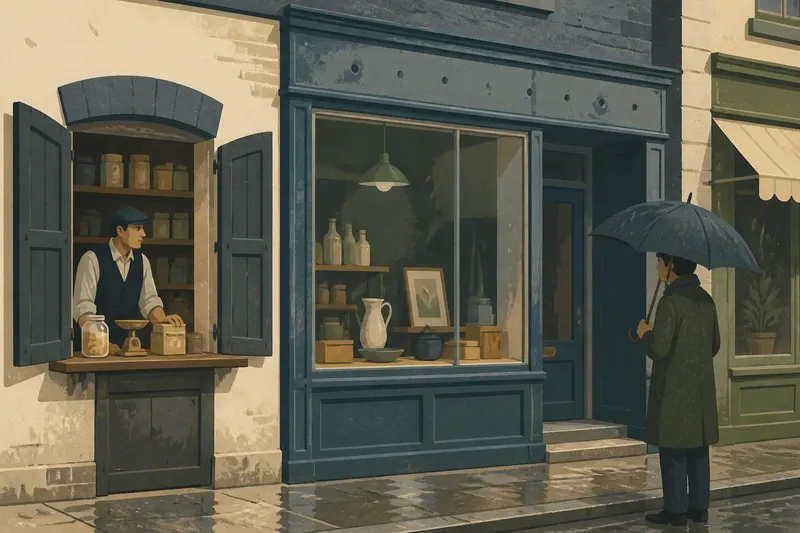
On a wet morning, a passer-by pauses beneath a shop awning to peer through the window. Shopfront history begins with that simple encounter: an edge between pavement and interior that lets people look, speak, enter or keep walking.
There was no single sequence that every shop followed. Openings, shutters, signs and glazed displays overlapped, and their form varied with local trades, materials and buildings. They are best read as different ways of managing the same street-facing boundary.
Openings and counters
Before large display windows were practical for a particular shop, goods could be shown through an opening in the front wall. A door or shutter might be moved aside during business hours, bringing a counter and merchandise close to the pavement.
The arrangement made the shopkeeper part of the street scene. A customer could ask a question from the opening without entering, while the counter marked a boundary between seller and visitor. The opening’s size also limited what could be seen and reached.
These details are clues, not a universal historical timeline. A surviving opening or altered wall may suggest how a shop once met the pavement, but later repairs and changes of use can complicate the reading.
Shutters at closing
A street-facing business needed a way to close its opening when trade stopped. Timber shutters, solid doors and grilles served that practical purpose. Some shutter arrangements could be moved aside during the day; their exact use depended on their design and the building.
Look for hinges, catches or shutter housings around an older opening. They can show where a closure was attached, though they do not by themselves establish when it was installed or how often it was used. A row of closed shopfronts also changed the feel of a street: displays and entrances gave way to more private, solid surfaces.
Glass and display
As larger panes became available for more building projects, glass offered shopkeepers another way to present goods. Merchandise could be arranged behind a transparent barrier, visible to people who did not enter. The display could remain in view outside trading hours, although access to the shop still depended on its door.
Glass changed the relationship between looking and touching. A passer-by might inspect an object from the pavement, but the window kept it apart from the street. That distinction remains clear in many shops: the display draws the eye, while the entrance controls movement inside.
Do not assume that every glazed frontage dates from the same period. Glass could be replaced, openings enlarged and older façades altered. Window frames, masonry joints and blocked openings may offer clues, but a single feature rarely settles the history.
Signs on the street
Fascia boards, painted lettering, awnings and window displays helped identify businesses at walking pace. A familiar name could guide a customer along a long street; a canopy could shelter the entrance or shade goods from direct sun.
These additions also compete for attention. A crowded sign can obscure architectural details, while a carefully placed name can make a doorway easier to pick out. Shopfront changes may also be subject to local planning rules or the requirements of a listed building, so owners should check with the relevant council or a qualified professional before altering historic fabric.
Read a shopfront?
Why did shops use shutters?
Shutters could close a street-facing opening when the shop was not trading. Their arrangement varied, so surviving hardware is a clue to the frontage rather than proof of a single standard practice.
When did display windows become common?
The shift towards larger glazed displays was gradual, as materials and building methods changed. Its timing differed between places and shops, so avoid assigning a date from glass alone.
Does a glass frontage make a shop easier to enter?
Not by itself. Glass may make a door or interior easier to see, but the threshold, doorway and route in determine whether the entrance is usable.
What should I inspect on an older shopfront?
Notice hinges, shutter housings, blocked openings, sign fixing points and changes in the wall or paving. Treat each as a clue, then compare it with the other features rather than drawing a firm conclusion from one detail.
A pavement-side reading
Say you are looking at an invented old shop with a broad window, a narrow door set back from the pavement and a line of filled holes above the glass. First, note the window and entrance separately. Then check whether the holes align like old sign fixings and whether the doorway has surviving hinges or a threshold change. If the holes form a neat line, an earlier sign may have been attached there; if they are irregular, repairs or another fitting remain possible. The result is a cautious reading: the frontage has changed, but its exact sequence is unresolved.
- If hinges or catches remain beside an opening, record their position; if they do not, avoid claiming that shutters were present and look for other evidence.
- If an opening has a visible lintel or altered brickwork, compare it with the surrounding wall; if the masonry differs, treat enlargement as possible and check for matching clues elsewhere.
- If sign holes form a regular row, consider a former fascia or sign; if they are scattered, treat them as uncertain and do not infer a specific sign design.
- If the door is recessed, notice whether it is visible along the pavement; if it is hidden from the approach, record that visibility trade-off rather than assuming the recess was only decorative.
- If the threshold differs from the adjoining pavement, note the change in level; if the route appears difficult to approach, describe the obstacle without assuming what caused it.
- If the window reveals goods but not the entrance, distinguish display from access; if the door is clearly visible as well, note how the frontage guides a visitor from looking to entering.
Shopfront history is written in working details: the opening that brought a counter near the pavement, the closure that secured it, and the glass that made looking possible without entry. On your next walk, compare one doorway with its window. The gap between what you can see and where you can go is often the most revealing part of the façade.