Why the Corner of a Street Changes How a Crossing Feels
Street corner geometry changes what you can see and how far a crossing feels. Learn what tight and broad corners suggest as you approach.
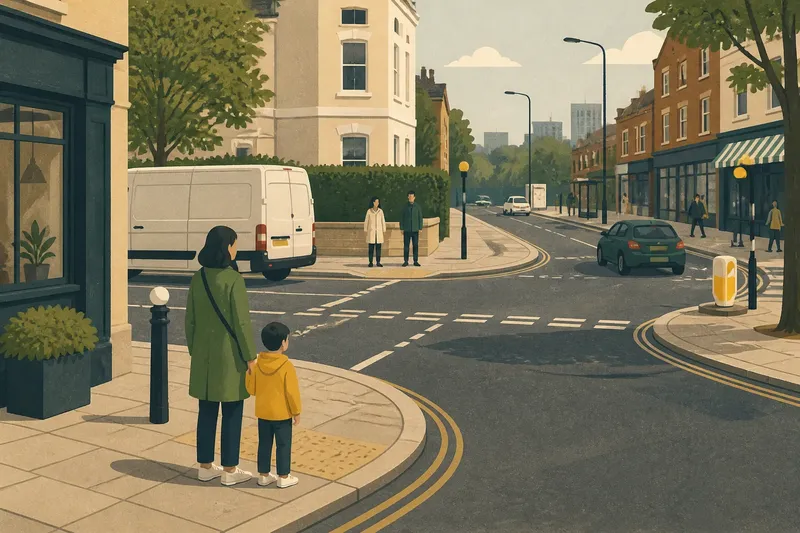
You reach the kerb at a junction and pause: a van blocks part of the view, the turning lane seems to sweep away, and the opposite pavement feels farther than it looked from half a block back. Street corner geometry helps explain that shift. The shape of the kerb changes the sightlines, the path your eyes trace across the road and the distance you seem to face.
A corner is not just a join between two pavements. Its curve, kerb line, waiting space and relationship to the junction influence where people stand and what they can see. To read one, start with your situation: are you crossing a quiet side street, a broad main road, or a junction where turning vehicles occupy much of the view? Different shapes suit different conditions, and none tells the whole story by itself.
For a narrow side street
A tight corner usually turns sharply, keeping the kerb close to the meeting point of the two streets. The crossing over a side road can consequently feel compact: the far pavement may appear within easy reach, and the route across is visually direct. That can make the junction legible, especially where the side street carries little traffic and the pavement is not crowded.
Look at the corner from the place where a person would actually wait, not from the middle of the pavement. A wall, hedge, parked car or street cabinet can block the view even when the kerb itself bends neatly. If you can see along the approaching street and towards the other side of the crossing, the compact corner may offer a clear reading of the junction. If the view closes abruptly, the apparent shortness of the crossing does not make it easy to judge.
For someone walking with a child, a pushchair or a shopping trolley, the question is also where there is room to wait without obstructing other pedestrians. A sharp corner can leave only a small patch of pavement between the building line and the kerb. A broader waiting area may matter more than a short-looking crossing when people need to pause, turn or pass one another.
For a broad, busy road
A broad kerb sweep often gives the junction an open, generous appearance. Yet it can make the crossing feel longer. The curve carries the pavement edge away from the corner, so the person waiting may stand farther from the point where the crossing begins. The far side can seem to drift across the view rather than sit directly opposite.
That impression is not simply a matter of road width. A wide turning path can leave more open tarmac between pavements and make vehicles appear to have a large arc through the junction. The eye follows that curve, which can make the space feel designed for movement around the corner rather than for a person walking straight across. At a signalised junction, the position of the crossing markings and waiting area can either clarify or complicate that reading.
Broad corners may also improve the view around a junction when nearby walls or planting would otherwise conceal approaching traffic. But a long, open curve can invite faster turns, and an exposed waiting spot may feel uncomfortable even if visibility is good. Read the whole scene: where does the kerb lead, where do turning vehicles travel, and is the intended crossing route obvious from the pavement?
For a blocked or awkward view
Sometimes neither a tight turn nor a broad sweep tells you enough. A parked vehicle near the corner can hide a person approaching the crossing. A signpost or utility cabinet can interrupt the sightline at pavement level. A building set close to the junction may create a blind edge, while trees or street furniture can narrow the place to stand.
In this situation, judge the corner from several ordinary viewpoints: approaching along each pavement, waiting at the kerb, and looking towards the opposite landing point. Notice what enters view only after you move closer. If the crossing appears to unfold in pieces, the geometry and the obstacles together are shaping how much information you can gather before stepping off the pavement.
Say you are considering a route to a local library and one corner has a wide curve but a delivery van often stands near the turn. You could compare it with a nearby crossing where the kerb is tighter and the approach stays visible. The useful observation is not that one shape is always safer, but whether the crossing point, waiting space and approaching traffic can be read from where you need to stand.
For a place people linger
At a high street corner or beside a busy stop, the pavement has more than one job. People may wait to cross, meet someone, check a map or step aside while others pass. A broad corner can provide more standing room, but the curved edge may place that room away from a direct crossing line. A tight corner may keep the route intuitive while leaving little space for a group.
Watch how people use the corner at different moments. Do they cluster near a shopfront, bunch around a signal pole, or spread along the kerb? Does the pavement funnel people towards one narrow point? These clues reveal whether the space accommodates its everyday uses or merely looks spacious in plan. The best fit depends on the local pattern: a simple residential junction has different demands from a corner serving a bus stop, school entrance or cluster of shops.
For street designers and residents discussing a change, describe the actual conflict rather than asking for a curve to be “bigger” or “smaller”. It may be that the crossing seems too long, the waiting area is pinched, or a turning vehicle blocks the view. Those are distinct problems. A kerb adjustment, clearer crossing alignment or relocation of street furniture might address one without worsening another; the appropriate design depends on the street and its rules.
Questions at the corner?
Does a tighter corner always feel shorter?
Often it makes the crossing look more direct, because the kerb stays close to the junction. But parked vehicles, a narrow pavement or a blocked view can make the same corner feel difficult to read.
Does a broad corner mean a longer crossing?
Not necessarily. A broad curve can make the far pavement seem more distant by carrying the kerb away from the junction, but the actual crossing route depends on the road layout and marked crossing point.
Why do turning vehicles change the impression?
Their path gives the eye a moving line to follow around the corner. A generous turning arc can make the junction feel open to vehicles while leaving a person on foot unsure where the direct route across begins.
What should I notice before choosing a route?
Check whether you can see approaching traffic, where there is room to wait, and whether the crossing leads clearly to the opposite pavement. If those features are hard to judge, consider another crossing that gives you a clearer view.
Read the whole junction
When comparing street corners, resist judging by the curve alone. A useful quick read is to notice:
- Kerb line: Does it keep the crossing close to the junction, or sweep the waiting point away?
- Sightline: Can you see along the road and towards the crossing landing point from the pavement?
- Waiting space: Is there room to pause without blocking the walking route?
- Turning path: Does the open area suggest a vehicle arc that dominates the corner?
- Obstacles: Do parked vehicles, signs, planting or cabinets hide part of the view?
- Crossing alignment: Does the marked route appear to connect naturally with the pavement on both sides?
Use the observations to match the corner to the situation. A compact corner can suit a small side street when the view is open and the waiting area works. A broader sweep may be easier to use where people need more room, provided the crossing remains clear and the turning movement does not overwhelm the space. Where visibility is the main concern, the obstruction may matter more than the curve.
Street corner geometry is easiest to understand while walking, because the view changes as you approach and turn. Next time a crossing feels unexpectedly long or confusing, note where you first see the far pavement and what blocks the view. That small distinction can tell you whether the strain comes from the corner’s shape, the street around it, or both.